


 音声読み上げ・
 Multilingual
 サイトマップ
 目的別検索
目的別検索 ごみの出しかた
 夜間・休日窓口
 パスポート
パスポート 施設案内
施設案内 所沢図書館
所沢図書館 事業者のみなさんへ
 公共施設予約システム
 電子申請
電子申請 申請書ダウンロード
Asahi Bridge
更新日:2026年3月13日
The Asahi bridge was originally constructed in 1911 (Meiji 44) to provide access to Japan’s first airfield, the Tokorozawa airfield. The initial bridge was originally comprised of a dirt bridge built alongside the Hikoki Shindo path to connect Tokorozawa station with the airfield.
As aviation activity increased and the airfield expanded in the early Showa period the road was increasingly used for transporting goods and aircraft. A new bridge was planned to accommodate the increased activity and the early rudimentary bridge was replaced after approximately two years of construction which was completed in March 1930 (Showa 5). The robust and modern design was a testament to the communities vision for “a bridge befitting the gateway to aviation city Tokorozawa”.
In August 2009 (Heisei 21), the Asahi bridge was designated as a registered tangible cultural property of Japan. This is a testament to its architectural and historical value.
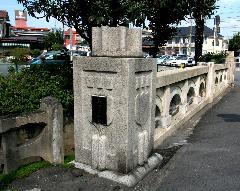
Main pillar before restoration
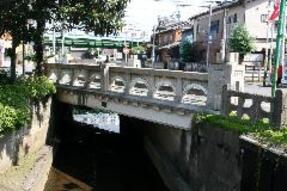
Railing before restoration
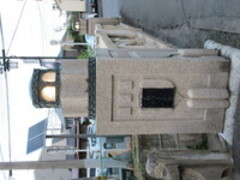
Main pillar after restoration
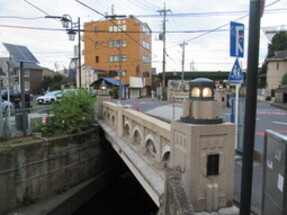
Main pillar and Railing after restoration
Key features
Structure
The bridge is a reinforced concrete, single-span beam bridge with a simple design where a single girder is supported at both ends. The bridge is approximately 10-10.4 metres long and 10-12 metres wide.
Decorative elements
The balustrades feature a rhythmic pattern of white tiled arches reflecting geometric sensibility and western architectural influence which helps to make this a truly unique and charming bridge.
Main pillars
The main pillars at each end of the bridge are crafted from Mannari Stone and are decorated with western style sculptural motifs.
Originally, each pillar was topped with a bronze, hexagonal lamp with arabesque designs which illuminated the bridge at night. These decorative lamps were lost for many years, believed to have been removed during the wartime metal collection drives.
They were restored in 2025 (Reiwa 7) to commemorate the 75th Anniversary of Tokorozawa City's founding.
These lamps have been reproduced to nearly the original size and material specifications. However, in their function, they feature modern specifications such as a solar power source and LED bulbs, fitting for Tokorozawa, an "Eco-Town."
 We publish the Tokorozawa City Cultural Heritage Information Paper, ‘Tokorozawa Cultural Heritage’.
お問い合わせ
所沢市 教育委員会教育総務部 文化財保護課
住所:〒359-0042 所沢市並木六丁目4番地の1
電話:04-2991-0308
FAX:04-2991-0309